| Table of Contents: -Quick Overview: Amrita B.Tech Admission Process -Two Admission Pathways (AEEE vs JEE Main) -Important Dates & Deadlines for AEEE 2026 -Eligibility Criteria: Academic Requirements & Age Limit -Step-by-Step Application Process -AEEE 2026 New Exam Pattern & Syllabus -Top B.Tech Programs & Specialisations -Campus-wise Placements & Average Packages -AEEE Cutoff Ranks & Expected Trends -CSAP Counselling Process Explained -Frequently Asked Questions (FAQs) -Decision Checklist: Is Amrita Right for You? |
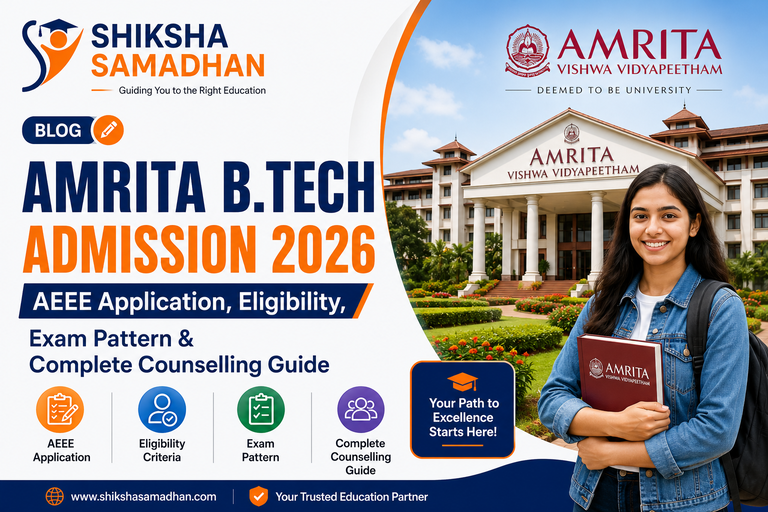
Planning to pursue B.Tech from a top private engineering college in India? Amrita Vishwa Vidyapeetham stands out as one of India’s most sought-after private universities for engineering education, offering unmatched flexibility in admissions, strong placement records, and diverse specialisations.
Unlike most private engineering colleges that rely on a single admission pathway, Amrita B.Tech admission 2026 offers two independent routes:
- AEEE 2026 rank (Amrita’s own entrance exam)
- JEE Main 2026 percentile (National-level exam score)
This comprehensive guide covers everything you need to know about Amrita B.Tech admission 2026, including:
✅ AEEE application process (step-by-step guide)
✅ Eligibility criteria (academic requirements & age limit)
✅ Exam pattern changes (new Quantitative Aptitude section)
✅ Application deadlines (Phase 1 & Phase 2 dates)
✅ Cutoff trends (branch-wise & campus-wise)
✅ Placement statistics (average package ₹8-10 LPA)
✅ CSAP counselling (seat allotment process)
✅ Campus comparison (8 locations across India)
Whether you’re targeting Amrita Coimbatore CSE, exploring mechanical engineering, or considering AI and Data Science, this guide provides actionable insights to help you make informed decisions.
How Does Amrita B.Tech Admission Work? Overview & Key Features
What is AEEE? Understanding the Amrita Entrance Examination
AEEE (Amrita Entrance Examination — Engineering) is a national-level Computer-Based Test conducted by Amrita Vishwa Vidyapeetham every year. It serves as the primary admission gateway for B.Tech programs across all eight Amrita campuses located across India.
Key Facts about AEEE 2026:
- Fully computerised (online CBT format)
- 110 exam centres across India and abroad (including Dubai)
- 100 multiple-choice questions (new pattern)
- Duration: 2 hours 30 minutes
- Total marks: 300
- Negative marking: -1 for each wrong answer
Amrita’s Eight Engineering Campuses
Amrita Vishwa Vidyapeetham operates engineering programs across eight strategically located campuses:
| Campus | Location | State | Avg. Package |
| Amrita Coimbatore | Ettimadai | Tamil Nadu | ₹9.05 LPA |
| Amrita Amritapuri | Kollam | Kerala | ₹9.04 LPA |
| Amrita Bengaluru | Carmelaram | Karnataka | ₹9.04 LPA |
| Amrita Chennai | Thiruvallur District | Tamil Nadu | ₹9.04 LPA |
| Amrita Amaravati | Mangalagiri | Andhra Pradesh | ₹9.04 LPA |
| Amrita Faridabad | Sector 88 | Haryana | ₹9.04 LPA |
| Amrita Haridwar | Haridwar | Uttarakhand | Data N/A |
| Amrita Nagercoil | Kanyakumari District | Tamil Nadu | Data N/A |
Note: Amrita Coimbatore (main campus) consistently has the highest demand and most competitive cutoff ranks.
Two Admission Pathways for Amrita B.Tech 2026
One of Amrita’s unique advantages is offering two independent admission routes. This means you’re not limited to a single entrance exam.
Pathway 1: AEEE 2026 Direct Exam
Who should take this path:
- Students who want a dedicated entrance exam without competing with JEE Main candidates
- Those preparing specifically for Amrita
- Students who miss good JEE Main percentiles and want an alternative
Advantages:
- Separate rank, separate seat allocation
- Dedicated exam pattern (customised for Amrita)
- Multiple exam phases (Phase 1 & Phase 2)
- Less competition compared to JEE Main
Disadvantages:
- AEEE rank is not accepted at IITs or NITs
- Limited to Amrita campuses only
- Requires additional exam preparation
Pathway 2: JEE Main 2026 Percentile
Who should take this path:
- Students targeting both IITs/NITs and Amrita
- Those already preparing for JEE Main
- Candidates wanting maximum flexibility in college choices
Advantages:
- Single exam serves multiple purposes (JEE Main score → IIT/NIT/Amrita)
- Wider scope (can apply to 1,000+ engineering colleges)
- Better cutoff chances through JEE percentile
- No need to appear for a separate AEEE exam
Disadvantages:
- Highly competitive (lakhs of candidates)
- JEE Main cutoff typically requires a 90+ percentile for Amrita CSE
- Limited seats for the JEE Main category at Amrita
Pathway 3: Both AEEE + JEE Main (Recommended Strategy)
Why most students choose this:
- Maximum flexibility – compete through both pathways
- If you score well in AEEE, secure a seat through that
- If you score well in JEE Main, secure a seat through that
- Belt-and-braces approach – no single exam dependency
Application fee: ₹1,300 (covers both exams)
Smart Strategy:
Step 1: Take AEEE Phase 1 (January 30 – Feb 1, 2026)
↓ (If the score is good, proceed to CSAP counselling)
↓ (If the score is below expectation, prepare for Phase 2)
Step 2: Simultaneously prepare for JEE Main (as backup)
Step 3: Take AEEE Phase 2 (April 24 – 30, 2026) if needed
Step 4: Take JEE Main (if not attempted yet)
Result: Compare both ranks and choose the best pathway for CSAP
| Feature | AEEE Only | JEE Main Only | Both (AEEE + JEE) |
| Colleges Eligible | Only Amrita | 1,000+ colleges | All options |
| Competition Level | Lower | Higher (Lakhs) | Flexible |
| Cost | ₹1,300 | ₹650/attempt | ₹1,300 |
| Exams Required | 1 | 1 | 1-2 |
| Flexibility | Limited | Limited | Maximum |
| Risk | Single exam dependency | Single exam dependency | None |
Recommendation: Apply through both AEEE + JEE Main for maximum flexibility.
Important Dates & Deadlines for Amrita B.Tech Admission 2026
Critical: Missing even one deadline can affect your admission. Therefore, mark all these dates in your calendar immediately.
Phase 1 Timeline (Already Conducted)
| Event | Date | Status |
| Phase 1 Exam | January 30 – February 1, 2026 | ✅ Completed |
| Phase 1 Results Declaration | Early February 2026 | ✅ Declared |
Phase 2 Timeline (Current – For Improvement Attempts)
| Event | Date | Remaining Time |
| Phase 2 Registration Opens | Early April 2026 | Active |
| Phase 2 Registration Deadline | April 18, 2026 | ⏰ Urgent |
| Phase 2 Slot Booking Start | April 10, 2026 | Started |
| Phase 2 Slot Booking Deadline | April 20, 2026 | Active |
| Phase 2 Exam Dates | April 24 – 30, 2026 | Upcoming |
| Phase 2 Admit Card Release | Before exam (post slot booking) | Coming |
| Phase 2 Results | May 2026 | Expected |
CSAP Counselling Timeline (Provisional)
| Event | Date | Status |
| CSAP Counselling Portal Opens | To be announced | Pending |
| Online Preference Filling | To be announced | Pending |
| Seat Allotment | To be announced | Pending |
| Admission Fee Payment Deadline | To be announced | Pending |
| Document Verification | June 2026 (approx) | Expected |
| Classes Commence | July 2026 (approx) | Expected |
⚠️ Latest Update: Amrita has extended the AEEE 2026 Phase 2 registration deadline to April 18, 2026. The Phase 2 exam is scheduled from April 24 to 30, 2026. Check the official portal (aeee.amrita.edu) for any further updates.
Pro Tip: Subscribe to notifications on the official AEEE portal to receive instant updates on schedule changes.
Amrita B.Tech 2026 Eligibility Criteria: Complete Requirements
Before filling out the application form, verify that you meet ALL eligibility requirements. Missing even one criterion can lead to application rejection.
Academic Requirements (Class 12 Qualifications)
Qualifying Examination:
- Class 12 (or equivalent like HSC, CBSE, ICSE, State Boards) from a recognised educational board
- Minimum percentage: 60% aggregate in PCM (Physics + Chemistry + Mathematics combined)
- 50% minimum in each subject individually (Physics, Chemistry, Mathematics separately)
Accepted Boards:
- Central Board of Secondary Education (CBSE)
- Indian Certificate of School Education (ICSE)
- State Boards (all states)
- International Boards (IGCSE, IB, etc.) – if recognised by the Indian government
- Open schooling (NIOS)
Example Calculation:
Class 12 Marks:
Physics: 78/100 (78%) ✅ Meets 50% requirement
Chemistry: 72/100 (72%) ✅ Meets 50% requirement
Maths: 80/100 (80%) ✅ Meets 50% requirement
Total PCM: 230/300 = 76.67% ✅ Meets 60% aggregate requirement
What if you haven’t cleared Class 12 yet?
- Candidates appearing in the Class 12 final exam can still apply
- At the time of counselling, you must produce passing certificates
- Any fraudulent marks will lead to blacklisting
Age Limit (Critical – Don’t Miss This)
Eligible Age Range:
- Born between July 1, 2005 and June 30, 2010
- Candidates outside this range are strictly ineligible
Example:
✅ Born June 15, 2008 → Eligible
❌ Born July 2, 2010 → Ineligible (too young)
❌ Born June 30, 2005 → Ineligible (too old)
✅ Born January 1, 2006 → Eligible
Why age limit exist?
- Ensures appropriate maturity level for the engineering curriculum
- Regulatory requirement from AICTE (All India Council for Technical Education)
- Consistent with Indian higher education standards
Entrance Exam Requirements
You must appear for at least ONE of these exams:
Option 1: AEEE 2026
- Amrita’s own entrance exam
- Multiple phases (Phase 1 already conducted, Phase 2 ongoing)
- CBT format with 100 MCQs
- No negative marking waiver for unattempted questions
Option 2: JEE Main 2026
- National-level exam conducted by NTA
- JEE Main score converts to a percentile
- Can be attempted multiple times (Jan/Apr/May sessions)
- Wider acceptance across engineering colleges
Option 3: Both AEEE + JEE Main (Recommended)
- Provides maximum flexibility
- Application fee: ₹1,300 for both exams
- Create separate login IDs for each exam
Complete Eligibility Checklist
| Criterion | Requirement |
| Class 12 Qualification | Passed from a recognised board |
| Physics | ≥50% in Class 12 |
| Chemistry | ≥50% in Class 12 |
| Mathematics | ≥50% in Class 12 |
| PCM Aggregate | ≥60% overall |
| Age Limit | Born between July 1, 2005, and June 30, 2010 |
| Entrance Exam | AEEE or JEE Main attempted |
| Nationality | Indian or NRI |
If all boxes are ☑️ checked, you’re eligible to apply!
Step-by-Step Application Process for Amrita B.Tech 2026
Follow this exact sequence to avoid application errors that could lead to rejection.
Step 1: Register on the Official AEEE Portal
Action:
- Visit aeee.amrita.edu (official portal)
- Click on “New Registration”
- Enter your active email ID and mobile number (which you’ll use for login)
- Create a strong password (8+ characters with numbers, symbols)
- Accept the terms and conditions
- Click “Register”
What happens next:
- A verification link is sent to your email
- An OTP is sent to your mobile number
- Click the verification link and enter the OTP to activate the account
- Your login credentials are confirmed
Timeline: Complete this within 24 hours of starting the application.
Step 2: Fill in the Application Form
After successful registration, log in and proceed:
Section A: Personal Information
- Full name (as per Class 12 certificate)
- Date of birth
- Gender
- Category (General/OBC/SC/ST)
- Disability status (if applicable)
- Nationality (Indian/NRI/International)
Section B: Contact Details
- Permanent address
- Current address
- Mobile number
- Email ID
- Parent/Guardian details
Section C: Academic Details
- Class 10 board and year of passing
- Class 12 board and year of passing
- Physics score (marks and percentage)
- Chemistry score (marks and percentage)
- Mathematics score (marks and percentage)
- Total PCM aggregate percentage (auto-calculated)
Section D: Exam Mode Selection Choose your admission pathway:
- AEEE 2026 only
- JEE Main 2026 only
- Both AEEE + JEE Main (Recommended)
Section E: Exam Centre Preference
- Select preferred exam centre city (from list of 110+ cities)
- Choose up to 3 cities in order of preference
- Slots allocated on a first-come, first-served basis
Section F: Declaration
- Tick all declarations confirming the accuracy of information
- Agree to terms and conditions
- Provide digital signature (upload as JPG/PNG)
Important: Every field is mandatory. Incomplete forms cannot be submitted.
Step 3: Pay the Application Fee
Fee Structure Based on Your Selection:
| Admission Mode | Fee | Refundable? |
| AEEE Only | ₹1,300 | ❌ Non-refundable |
| JEE Main Only | ₹500 | ❌ Non-refundable |
| AEEE + JEE Main | ₹1,300 | ❌ Non-refundable |
| International Exam Centres | USD 85 / ₹7,000 | ❌ Non-refundable |
| Phase 2 Exam (additional) | ₹600 | ❌ Non-refundable |
Payment Options:
- Debit card
- Credit card
- NetBanking
- UPI payment
- Payment gateway integration (PayTM, Google Pay, etc.)
⚠️ Critical: The application fee is completely non-refundable. Therefore, verify all your details before clicking “Pay.”
Step 4: Upload Required Documents
Prepare these documents before starting the application:
Document 1: Passport-size Photograph
- Size: 4cm × 6cm (or 200 × 300 pixels)
- Format: JPG or PNG only
- File size: 50 KB – 500 KB
- Requirements: Clear face, no filters, white background (recent)
- Angle: Straight facing, no tilting
Document 2: Digital Signature
- Size: 3cm × 1cm (or 150 × 50 pixels)
- Format: JPG or PNG only
- File size: 10 KB – 50 KB
- Write your signature on white paper, scan/photograph, and upload
Document 3: Class 10 Certificate
- Upload a scanned copy of the mark sheet
- Format: JPG, PNG, or PDF
- All information must be clearly visible
- File size: < 2 MB
Document 4: Class 12 Certificate
- Upload a scanned copy of the mark sheet/passing certificate
- Format: JPG, PNG, or PDF
- Must clearly show Physics, Chemistry, and Mathematics marks
- File size: < 2 MB
Upload Process:
- Click “Choose File” next to each document field
- Select a file from your device
- Verify the upload is 100% complete
- Move to the next document
Important: Ensure all documents are clearly visible and legible. Blurry or incomplete uploads may result in rejection during document verification.
Step 5: Application Review and Final Submission
Before clicking “Final Submit”:
- ✅ Re-read all personal details (name, DOB, email, phone)
- ✅ Verify academic marks (Physics, Chemistry, Mathematics)
- ✅ Confirm exam centre choices
- ✅ Check admission mode selected (AEEE/JEE Main/Both)
- ✅ Ensure all documents are uploaded clearly
- ✅ Verify digital signature uploaded
- ✅ Confirm terms and conditions accepted
Click “Final Submit” (irreversible – you cannot edit after this)
After Submission:
- You’ll receive a confirmation page with your Application ID
- Save/download this confirmation page as a PDF
- A confirmation email will be sent to your registered email ID
- Print the confirmation page for future reference
Step 6: Book Your Exam Slot (Phase 2)
Timing: After successful application submission
Slot Booking Window for Phase 2:
- Opens: April 10, 2026
- Closes: April 20, 2026
- Exams: April 24-30, 2026
How to Book:
- Log in to aeee.amrita.edu using your credentials
- Click “Slot Booking”
- System displays available slots for your chosen exam centre city
- 3 exam slots available per day (Morning, Afternoon, Evening)
- Select your preferred date and time slot
- Confirm booking (slots are final and non-changeable after booking)
Slot Availability Example:
April 24, 2026 – Your Exam Centre City (e.g., Mumbai)
├─ 9:00 AM – 11:30 AM [Available] [Book]
├─ 2:00 PM – 4:30 PM [Available] [Book]
└─ 5:00 PM – 7:30 PM [Available] [Book]
April 25, 2026
├─ 9:00 AM – 11:30 AM [Full]
├─ 2:00 PM – 4:30 PM [Available] [Book]
└─ 5:00 PM – 7:30 PM [Available] [Book]
…and so on
Pro Tips:
- Book as early as possible (slots fill on a first-come, first-served basis)
- Choose a time slot when you typically perform best (morning person vs. night owl)
- Avoid slots immediately after other major exams (your brain will be tired)
- Leave buffer time before your preferred date (delays can occur)
After Slot Booking:
- The admit card becomes available 2-3 days before your exam
- Download and print the admit card immediately
- Verify all details (Name, Roll Number, Exam Centre, Date, Time)
- Report to the exam centre 1 hour before your exam time
AEEE 2026 New Exam Pattern: Key Changes & Implications
What’s New in the AEEE 2026 Exam Pattern?
Major Change: A new Quantitative Aptitude section with 10 questions has been added to AEEE 2026. This is a significant departure from previous years and requires dedicated preparation.
Overall Exam Structure
| Parameter | Details |
| Mode | Online — Computer-Based Test (CBT) |
| Total Questions | 100 MCQs (multiple-choice questions) |
| Total Marks | 300 marks |
| Duration | 2 hours 30 minutes (150 minutes) |
| Marking Scheme | +3 for correct, -1 for wrong |
| Unattempted Questions | No penalty (0 marks) |
| Medium | English only |
| Exam Centres | 110+ cities (India + Dubai, Singapore, Malaysia) |
Section-wise Breakdown (New Pattern)
| Section | Questions | Marks | % of Paper | Time Allocation |
| Mathematics | 40 | 120 | 40% | 50 minutes |
| Physics | 25 | 75 | 25% | 30 minutes |
| Chemistry | 20 | 60 | 20% | 25 minutes |
| Quantitative Aptitude | 10 | 30 | 10% | 15 minutes |
| English | 5 | 15 | 5% | 5 minutes |
| TOTAL | 100 | 300 | 100% | 150 minutes |
Changes from Previous Year:
Previous Pattern:
├─ Mathematics: 40 questions
├─ Physics: 25 questions
├─ Chemistry: 25 questions (now reduced to 20)
└─ English: 10 questions (now reduced to 5)
New Pattern (2026):
├─ Mathematics: 40 questions (same)
├─ Physics: 25 questions (same)
├─ Chemistry: 20 questions (-5)
├─ Quantitative Aptitude: 10 questions (NEW)
└─ English: 5 questions (-5)
Quantitative Aptitude Section (New) – What to Expect
Topics Covered (Typical):
- Arithmetic (percentage, profit/loss, ratio, proportion, speed-distance-time)
- Algebra (linear equations, quadratic equations, inequalities)
- Geometry (basic shapes, areas, perimeters)
- Data interpretation (tables, graphs, pie charts)
- Number theory (HCF, LCM, divisibility, prime numbers)
- Set theory (basic set operations)
Difficulty Level: Class 10-11 mathematics level
Preparation Strategy:
- 10 questions × 3 marks each = 30 marks (10% of total)
- Even if you solve 5-6 correctly, you get 15-18 marks
- Focus on accuracy over speed (negative marking applies)
- Practice 30-40 different types of questions
Mathematics Section (40 Questions, 120 Marks)
Topics from Class 11-12 PCM Syllabus:
Algebra:
- Polynomials and quadratic equations
- Sequences and series (AP, GP)
- Complex numbers
- Permutations and combinations
- Binomial theorem
- Mathematical induction
Trigonometry:
- Trigonometric ratios and identities
- Heights and distances
- Inverse trigonometric functions
- Solutions of triangles
Calculus:
- Limits and continuity (basic)
- Differentiation (basics)
- Integration (basics)
- Application of derivatives
Geometry & Coordinate Geometry:
- Straight lines
- Circles
- Conic sections (parabola, ellipse, hyperbola)
- Three-dimensional geometry (basic)
Vectors:
- Vector algebra
- Scalar and cross products
Linear Algebra:
- Matrices and determinants
- Systems of linear equations
Preparation Tips:
- Mathematics carries 40% of the total marks (120/300)
- Scoring 70-80% in this section is achievable with consistent practice
- Focus on concepts rather than memorisation
- Solve previous years’ question papers
- Practice mental math and shortcuts for time management
Physics Section (25 Questions, 75 Marks)
Topics from Class 11-12 Curriculum:
Class 11 Physics Topics:
- Mechanics (Motion, Forces, Newton’s Laws)
- Work, Energy, Power
- Rotational Motion
- Gravitation
- Oscillations and Waves
- Elasticity and Properties of Matter
- Fluids
Class 12 Physics Topics:
- Electrostatics
- Current and Electricity
- Magnetic Effects of Current
- Magnetism
- Electromagnetic Induction
- Alternating Current
- Electromagnetic Waves
- Optics (Light and Reflection/Refraction)
- Modern Physics (Atoms and Nuclei)
- Electronic Devices
Difficulty Pattern:
- Conceptual questions (40%)
- Numerical problems (40%)
- Application-based (20%)
Preparation Strategy:
- Understand derivations thoroughly (don’t memorise)
- Practice numerical problems with multiple methods
- Focus on SI units and dimensional analysis
- Memorise important constants and formulas
- Solve previous years’ questions to understand question types
Chemistry Section (20 Questions, 60 Marks)
Topics from Class 11-12 Curriculum:
Inorganic Chemistry Topics:
- Periodic table and periodicity
- Atomic structure and bonding
- States of matter (gases, liquids, solids)
- Thermodynamics
- Equilibrium
- Redox reactions and electrochemistry
- P-block elements (especially Group 17, 18)
- D-block and f-block elements
Organic Chemistry Topics:
- Nomenclature and isomerism
- Hydrocarbons (alkanes, alkenes, alkynes)
- Functional groups (alcohols, aldehydes, carboxylic acids)
- Organic reactions and mechanisms
Physical Chemistry Topics:
- Mole concept and stoichiometry
- Kinetics
- Surface chemistry
Preparation Tips:
- Memorise periodic table trends (Ionization energy, electronegativity, etc.)
- Understand reaction mechanisms (not just remember reactions)
- Practice balancing chemical equations
- Focus on organic chemistry (high weightage in most entrance exams)
- Use mnemonics for remembering complex reactions
English Section (5 Questions, 15 Marks)
Question Types Typically Asked:
- Comprehension (1-2 passages) — Answer questions based on a given English passage
- Grammar and Vocabulary (2-3 questions) — Fill in blanks, error correction
- Sentence Formation (1-2 questions) — Arrange jumbled words/sentences
- Reading Comprehension (1 question) — True/false or multiple choice based on passage
Difficulty Level: Class 10-11 level
Quick Tips:
- Read passages carefully before answering questions
- Look for keywords in passages
- Don’t assume information not explicitly mentioned
- Time management: Spend only 5-7 minutes on this section
- Easy section to score 12-15 marks if focused
Exam Day Rules & Regulations
Rules to Follow (Strictly Enforced):
✅ Allowed Items:
- Admit card (compulsory)
- Photo ID (Aadhaar/Passport/School ID)
- Pen (bring 2-3 ballpoint pens)
- Transparent water bottle
- Transparent pouch for personal items
❌ Strictly Prohibited:
- Mobile phones, smartwatches, earphones, headphones
- Calculators, logarithmic tables, slide rules
- Programmable devices, USB drives
- Pencils, erasers, blank paper (any notes)
- Books, guides, coaching materials
- Cameras, recording devices
- Weapons or harmful items
- Electronic gadgets of any kind
Exam Hall Conduct:
- Arrive 30-45 minutes before exam start time
- Comply with security procedures (frisking, bag checking)
- Keep your admit card and ID visible at all times
- Questions about exam instructions? Ask the invigilator before the exam starts
- No talking or communication during the exam
- No looking at others’ screens
- Raise your hand if facing technical issues
If You Break Rules:
- ❌ Your exam will be cancelled
- ❌ You’ll be blacklisted for future attempts
- ❌ No refund of the application fee
- ❌ May face legal consequences
Post-Exam Procedure:
- Submit all materials (scratch paper, etc.) to the invigilator
- Do NOT click outside the exam window before submitting
- Exit only after the invigilator’s permission
- The result will be declared within 1-2 weeks
AEEE 2026 Preparation Strategy: Score 250+/300
Realistic Timeline for Preparation
For AEEE Phase 2 (Exam: April 24-30, 2026):
Now (Early April) → 2-3 weeks remaining
├─ Week 1: Focus on weak areas (narrow your focus)
├─ Week 2: Solve full-length mock tests
├─ Week 3: Quick revision + last-minute tips
└─ Exam week: Rest, revision, confidence building
Study Schedule (Recommended):
| Time Slot | Activity | Duration |
| 6:00 AM – 7:00 AM | Revision (formulas, concepts) | 1 hour |
| 7:00 AM – 10:00 AM | Practice problems (Mathematics) | 3 hours |
| 10:00 AM – 11:00 AM | Break/Tea/Snacks | 1 hour |
| 11:00 AM – 1:00 PM | Study new concepts OR Physics | 2 hours |
| 1:00 PM – 2:00 PM | Lunch break | 1 hour |
| 2:00 PM – 5:00 PM | Chemistry practice | 3 hours |
| 5:00 PM – 6:00 PM | Break | 1 hour |
| 6:00 PM – 8:00 PM | Full-length mock test | 2 hours |
| 8:00 PM onwards | Relax, light dinner, sleep | 2+ hours |
Total daily study: 6-7 focused hours (plus mock tests)
Resources for AEEE Preparation
Best Reference Books:
- Mathematics: R.D. Sharma, Arihant, MTG
- Physics: H.C. Verma, Arihant, NCERT
- Chemistry: NCERT, O.P. Tandon, Arihant
- Quantitative Aptitude: Arun Sharma, R.S. Aggarwal
Online Resources:
- Unacademy, Khan Academy, YouTube channels (Physics Wallah, JEE Simplified)
- Previous years’ AEEE question papers (download from aeee.amrita.edu)
- Amrita’s official practice tests
Mock Tests:
- Solve at least 10-15 full-length mock tests before the exam
- Mimic exam conditions (2.5 hours, no breaks, strict no phone rule)
- Analyse performance after each test
Top B.Tech Programs at Amrita Vishwa Vidyapeetham
Most Popular Specialisations (2026)
Amrita offers diverse B.Tech specialisations designed to align with industry demands and emerging technologies.
| Program | Duration | Specialization | Avg. Package | Top Recruiters |
| B.Tech | 4 years | Computer Science & Engineering (CSE) | ₹12-15 LPA | Microsoft, Amazon, Google, TCS, Infosys |
| B.Tech | 4 years | Artificial Intelligence & Data Science (AI & DS) | ₹11-14 LPA | Amazon, Google, JPMorgan, Goldman Sachs |
| B.Tech | 4 years | Electronics & Communication Engineering (ECE) | ₹8-10 LPA | Qualcomm, Intel, Samsung, Broadcom |
| B.Tech | 4 years | Mechanical Engineering | ₹7-9 LPA | Bosch, L&T, Maruti Suzuki, BHEL |
| B.Tech | 4 years | Civil Engineering | ₹6-8 LPA | L&T, Infrastructure companies, BHEL |
| B.Tech | 4 years | Chemical Engineering | ₹8-10 LPA | BASF, Reliance, IOC, Bajaj |
Computer Science & Engineering (CSE) — Most Popular
Why CSE at Amrita is in High Demand:
- Highest average package: ₹12-15 LPA
- 100% placement rate in recent years
- Strong placement in IT companies, startups, and fintech
- Curriculum aligned with AI/ML, Cloud Computing, Cybersecurity
- Multiple specialisation options (mentioned below)
CSE Specialisation Options (if available):
- Traditional Computer Science
- Artificial Intelligence
- Cybersecurity
- Cloud Computing
- Data Science
- Web Development
Career Scope Post-Graduation:
- Software Developer at IT companies (TCS, Infosys, Wipro)
- Product Engineer at product companies (Amazon, Microsoft, Google)
- Data Scientist at fintech/AI companies
- Startup co-founder (several Amrita alumni have founded startups)
- Full-stack developer in startups
Artificial Intelligence & Data Science (AI & DS) — Emerging Favorite
Why AI & DS are Growing:
- New and highly in-demand specialization
- Average package: ₹11-14 LPA
- Placement in tech giants, fintech, and healthcare companies
- Strong industry demand for AI/ML engineers
Curriculum:
- Machine learning and deep learning
- Data structures and algorithms
- Cloud computing (AWS, Google Cloud)
- Big data analytics
- Python, R programming
- Real-world projects with industry partners
Career Opportunities:
- Machine Learning Engineer at FAANG companies
- Data Scientist at fintech companies
- AI Research at tech companies
- Startup co-founder (AI-based solutions)
Electronics & Communication Engineering (ECE)
Core Focus:
- Semiconductor design and manufacturing
- Microwave and wireless communication
- Embedded systems
- IoT (Internet of Things)
- VLSI design
Placement Highlights:
- Average package: ₹8-10 LPA
- Top recruiters: Qualcomm, Intel, Samsung, Broadcom, Texas Instruments
- Roles: Chip design engineer, Embedded systems engineer, Firmware developer
Mechanical Engineering
Core Focus:
- Thermal systems and engines
- Manufacturing processes
- Robotics and automation
- CAD and CAM
- Machine design
Placement Highlights:
- Average package: ₹7-9 LPA
- Top recruiters: Bosch, L&T, Maruti Suzuki, BHEL, Mahindra & Mahindra
- Roles: Design engineer, Manufacturing engineer, Product engineer
Amrita Campus-wise Placements & Average Packages 2025
Campus Comparison Table
| Campus | Location | State | Avg. Package | Highest Package | Placement % | Top Recruiters |
| Coimbatore (Main) | Ettimadai | Tamil Nadu | ₹9.05 LPA | ₹50+ LPA | 95%+ | Amazon, Microsoft, TCS |
| Amritapuri | Kollam | Kerala | ₹9.04 LPA | ₹45+ LPA | 92%+ | Microsoft, TCS, Infosys |
| Bengaluru | Carmelaram | Karnataka | ₹9.04 LPA | ₹40+ LPA | 93%+ | Amazon, Google, TCS |
| Chennai | Thiruvallur | Tamil Nadu | ₹9.04 LPA | ₹35+ LPA | 90%+ | TCS, Wipro, Infosys |
| Amaravati | Mangalagiri | Andhra Pradesh | ₹9.04 LPA | ₹30+ LPA | 88%+ | TCS, Infosys, Wipro |
| Faridabad | Sector 88 | Haryana | ₹9.04 LPA | ₹25+ LPA | 85%+ | TCS, Infosys, HCL |
| Haridwar | Haridwar | Uttarakhand | Data N/A | Data N/A | Data N/A | Data N/A |
| Nagercoil | Kanyakumari | Tamil Nadu | Data N/A | Data N/A | Data N/A | Data N/A |
Overall Placement Highlights (2025)
| Metric | Details |
| Average Package | ₹8 – 10 LPA |
| Median Package | ₹8.5 LPA |
| Highest Package | ₹50+ LPA |
| Placement Rate | 90%+ across campuses |
| Companies Recruiting | 200+ companies |
| International Offers | Yes (select students) |
Top Recruiting Companies at Amrita
Tier 1 (Highest Paying):
- Microsoft (₹18-25 LPA for CSE)
- Amazon (₹15-22 LPA)
- Google (₹18-28 LPA)
- Goldman Sachs (₹20-30 LPA)
- DE Shaw (₹20-35 LPA)
Tier 2 (High Paying):
- TCS (₹8-15 LPA)
- Infosys (₹8-14 LPA)
- Wipro (₹8-12 LPA)
- Deloitte (₹10-16 LPA)
- Capgemini (₹9-13 LPA)
Tier 3 (Startups & Others):
- Flipkart, Swiggy, OYO (₹10-18 LPA for experienced)
- Unacademy, Vedantu (₹8-12 LPA)
- FinTech companies
Campus-wise Comparison: Which is Best?
Best for CSE: Coimbatore > Bengaluru > Amritapuri
Best for Overall Placements: Coimbatore (highest demand, best packages)
Best for Location: Bengaluru (IT hub, startup ecosystem)
Best for Value: Amaravati, Faridabad (newer campuses, similar packages)
Recommendation: Coimbatore CSE is the most competitive but offers the highest returns. However, if you’re borderline for Coimbatore, aim for Bengaluru or Amritapuri.
AEEE 2026 Expected Cutoff Ranks & Branch-wise Trends
Important: Cutoffs Vary Year-to-Year
Critical Note: Amrita does NOT publish a fixed cutoff system. Instead, seat allocation depends on:
- Your AEEE rank
- Number of applications received
- Your campus and branch preferences
- Overall merit pool quality
The figures below are historical trends based on previous years and should be used as rough benchmarks only, not guaranteed cutoffs.
Expected AEEE Rank Cutoffs by Branch (All Campuses Combined)
| Branch | Expected AEEE Rank Range | Expected JEE Percentile | Difficulty in Securing |
| CSE | 1 – 3,000 | 95 – 99+ | Very Difficult |
| AI & Data Science | 2,000 – 5,000 | 92 – 98 | Difficult |
| ECE | 3,000 – 7,000 | 90 – 96 | Moderate |
| Mechanical | 7,000 – 15,000 | 80 – 90 | Moderate to Easy |
| Civil | 10,000 – 20,000 | 75 – 85 | Relatively Easy |
| Chemical | 8,000 – 16,000 | 78 – 88 | Moderate to Easy |
Campus-wise Cutoff Variations
Cutoffs are NOT uniform across campuses. Coimbatore (main campus) has significantly higher competition:
CSE Branch Cutoffs (By Campus):
| Campus | AEEE Rank Range | Difficulty |
| Coimbatore (Main) | 1 – 800 | Very Difficult |
| Bengaluru | 800 – 2,000 | Difficult |
| Amritapuri | 1,500 – 2,500 | Moderate-Difficult |
| Chennai | 2,000 – 3,000 | Moderate |
| Amaravati | 2,500 – 3,500 | Moderate-Easy |
| Faridabad | 2,800 – 4,000 | Moderate-Easy |
Key Insight: If your AEEE rank is around 3,000-5,000, you’re very likely to secure a seat in non-CSE branches or CSE at newer campuses (Amaravati, Faridabad).
Factors Affecting Cutoffs (Year-to-Year Variations)
1. Number of AEEE Applicants
More applicants → Higher cutoffs
Fewer applicants → Lower cutoffs
Typical range: ±500-1000 rank shift
2. JEE Main Performance
If JEE Main is too difficult → Many opt for Amrita AEEE
If JEE Main cutoffs are lenient → Fewer students choose Amrita
3. Amrita’s Seat Availability
More seats available → Lower cutoffs
Fewer seats → Higher cutoffs
Seats vary by campus and branch
4. Previous Year Trends
If the previous year’s cutoff was 3,000 for CSE
This year could be 2,800-3,200 (variation expected)
Rarely jumps dramatically unless major change
Cutoff Strategy: How to Use This Information
If Your AEEE Rank is:
Rank 1-1,000:
├─ ✅ Secured CSE at Coimbatore
├─ ✅ Secured CSE/AI at any campus
└─ ✅ Choose any branch + campus
Rank 1,000-3,000:
├─ ✅ CSE at Bengaluru/Amritapuri
├─ ✅ Any branch at Coimbatore
├─ ✅ CSE at other campuses
└─ ⚠️ Stretch for CSE Coimbatore
Rank 3,000-5,000:
├─ ✅ CSE at newer campuses
├─ ✅ AI & DS at any campus
├─ ✅ ECE at any campus
└─ ❌ CSE Coimbatore unlikely
Rank 5,000-10,000:
├─ ✅ ECE/Mechanical at any campus
├─ ✅ All branches at new campuses
└─ ❌ CSE even at newer campuses
Rank 10,000+:
├─ ✅ Mechanical/Civil/Chemical
├─ ✅ Non-technical branches
└─ ❌ CSE/ECE very unlikely
Amrita B.Tech Counselling: The CSAP Process Explained
What is CSAP? Understanding Amrita’s Counselling System
CSAP = Centralised Seat Allotment Process
Unlike many other engineering colleges that use JoSAA or state-level counselling, Amrita conducts its own independent counselling called CSAP. This means:
- ✅ Amrita manages seat allocation directly
- ✅ Completely separate from JEE Main counselling
- ✅ Based on your AEEE rank or JEE percentile
- ✅ Your choice, your campus allocation
CSAP Counselling Timeline
| Step | Activity | Timeline | Action Required |
| 1 | Results Declaration | May 2026 (approx) | Check your AEEE rank |
| 2 | CSAP Portal Opens | June 2026 (approx) | Register on the portal |
| 3 | Preference Filling | 3-5 days window | Fill campus + branch preferences |
| 4 | Seat Allotment | June 15-20, 2026 (approx) | Check the allotted college |
| 5 | Admission Fee Payment | Within 2-3 days | Secure your seat |
| 6 | Document Verification | June 2026 | Submit original documents |
| 7 | Classes Begin | July 2026 | Attend orientation |
Step-by-Step CSAP Process
Step 1: Register on the CSAP Portal
When CSAP opens (announced after results):
- Visit the Amrita CSAP portal (link will be provided on aeee.amrita.edu)
- Log in using your AEEE login credentials (same email/password from the application)
- Verify your details displayed (Name, Roll Number, AEEE Rank)
- Confirm eligibility for seat allotment
Step 2: Fill Preferences (Most Critical Step)
This is where you decide where you want to study. You can fill up to 8-10 preferences in order of priority.
Preference Format:
Preference 1: Coimbatore – CSE (Dream choice)
Preference 2: Bengaluru – CSE (Realistic choice)
Preference 3: Amritapuri – CSE (Safe choice)
Preference 4: Chennai – AI & DS (Backup option)
Preference 5: Amaravati – ECE (Safe option)
Preference 6: Coimbatore – ECE (Backup)
Preference 7: Bengaluru – Mechanical (Fallback)
Preference 8: Any campus – Any branch (Last resort)
Pro Tips for Preference Filling:
- Use College Predictor First:
- Identify realistic campus-branch combinations based on your rank
- Shiksha Samadhan or a similar tool helps here
- Avoid wasting slots on unreachable targets
- Categorise Your Choices:
- Dream (1-2 slots): Coimbatore CSE, Bengaluru CSE (might not get, but worth trying)
- Realistic (3-4 slots): Amritapuri CSE, Chennai CSE, Amaravati AI & DS
- Safe (2-3 slots): ECE/Mechanical at various campuses
- Fallback (1-2 slots): Non-technical branches or any campus-branch
- Order Matters:
- Rank preferences in exact order of your preference
- The system allots a seat from the highest priority that matches your rank
- Once a seat is allotted, the remaining preferences are discarded
- Strategic Approach:
- Don’t list the same branch at all campuses (reduces chances)
- Mix branches to broaden your options
- Prioritise campus location and infrastructure if budget/relocation is a concern
- Prioritise placement records if career is the primary goal
Step 3: Receive Seat Allotment
After the preference filling window closes:
- Amrita processes all preferences
- Allotment algorithm runs (based on rank and preferences)
- You receive ONE allotted seat (campus + branch)
- Allotment result displayed on the CSAP portal
Example Allotment Scenario:
You filled preferences:
1. Coimbatore CSE
2. Bengaluru CSE
3. Amritapuri CSE
4. Chennai ECE
Your AEEE rank: 5,000
System checks:
├─ Coimbatore CSE: Cutoff 1-3,000 → ❌ Not eligible (rank 5,000)
├─ Bengaluru CSE: Cutoff 800-2,000 → ❌ Not eligible (rank 5,000)
├─ Amritapuri CSE: Cutoff 1,500-2,500 → ❌ Not eligible (rank 5,000)
└─ Chennai ECE: Cutoff 3,000-7,000 → ✅ ELIGIBLE!
ALLOTTED: Chennai, Electronics & Communication Engineering
Step 4: Accept Allotment & Pay Admission Fee
After getting your seat:
- Acceptance deadline: Usually 2-3 days from allotment
- Pay admission fee (typically ₹1,00,000 – ₹3,00,000, varies by course)
- Payment methods: Online transfer, demand draft, net banking
- After payment: You’re officially admitted!
If You Don’t Accept:
- ❌ Your seat is forfeited
- ❌ No refund of fees (if already paid)
- ❌ Cannot participate in spot counselling later
- ❌ Lose the opportunity to study at Amrita
Step 5: Document Verification
Timeline: Announced after admission fee payment (usually 1-2 weeks)
Documents Required (Original + Photocopy):
- Class 10 mark sheet
- Class 12 mark sheet/passing certificate
- Admission fee receipt
- AEEE admit card
- Aadhar card / Photo ID
- Cast certificate (if applicable – SC/ST/OBC)
- Income certificate (if claiming scholarship)
What Happens During Verification:
- Staff cross-checks documents with original records
- Photographs taken for college ID
- Hostel allotment (if applicable)
- Orientation session participation
- Fee deposit finalisation
If Documents Don’t Match:
- ❌ Your admission can be cancelled
- ❌ Fees forfeited
- ❌ Legal action possible (if fraud detected)
- Therefore, upload only accurate information during the application
Frequently Asked Questions (FAQs) on Amrita B.Tech Admission 2026
Q1: What is the minimum eligibility for Amrita B.Tech admission?
A: Candidates must pass Class 12 with Physics, Chemistry, and Mathematics, scoring 60% aggregate in PCM and 50% minimum in each subject individually. Age limit: born between July 1, 2005 and June 30, 2010. Additionally, you must take either AEEE or JEE Main or both.
Q2: Does Amrita accept JEE Main scores for admission?
A: Yes, absolutely. Amrita offers two independent admission pathways:
- AEEE rank (Amrita’s own entrance exam)
- JEE Main percentile (National-level exam)
You can apply via AEEE only, JEE Main only, or both simultaneously for maximum flexibility.
Q3: Does Amrita accept JEE Advanced scores?
A: No, Amrita does NOT accept JEE Advanced scores. Admissions are offered only through AEEE rank or JEE Main percentile. If you’ve taken JEE Advanced, you need to appear for AEEE or provide JEE Main score.
Q4: What are the new changes in AEEE 2026 exam pattern?
A: Major changes include:
- New Quantitative Aptitude section with 10 questions (30 marks)
- Chemistry reduced from 25 to 20 questions (60 marks)
- English reduced from 10 to 5 questions (15 marks)
- Mathematics and Physics remain unchanged (40 + 25 questions)
- Total: 100 questions for 300 marks in 2.5 hours
Q5: What is CSAP, and how does Amrita counselling work?
A: CSAP = Centralised Seat Allotment Process — Amrita’s own internal counselling system. Unlike JoSAA, CSAP is completely managed by Amrita. Process: Register → Fill preferences → Receive allotment → Accept seat → Document verification.
Q6: What are the expected AEEE cutoff ranks for CSE at Amrita 2026?
A: Based on historical trends:
- CSE Coimbatore: Rank 1-800 (very difficult)
- CSE Bengaluru: Rank 800-2,000 (difficult)
- CSE Amritapuri: Rank 1,500-2,500 (moderate)
- CSE Chennai: Rank 2,000-3,000 (moderate-easy)
- CSE Amaravati/Faridabad: Rank 2,500-4,000 (easier)
Note: Cutoffs vary yearly based on applications and the merit pool.
Q7: What is the average placement package at Amrita?
A: ₹8-10 LPA across all campuses. Top 10% students get ₹15-50+ LPA. Branch-wise: CSE ₹12-15 LPA, AI & DS ₹11-14 LPA, ECE ₹8-10 LPA, Mechanical ₹7-9 LPA.
Q8: Is Amrita Coimbatore significantly better than other campuses?
A: Yes, Coimbatore (main campus) has:
- Highest average package (₹9.05 LPA vs. ₹9.04 at others)
- Strongest reputation and legacy
- Most reputed faculty
- Better infrastructure
- However, the difference is marginal (₹0.01 LPA). Other campuses (Bengaluru, Amritapuri) offer similar placements.
Q9: Can I change my branch after admission?
A: Most universities (including Amrita) allow limited branch changes after Year 1 based on:
- CGPA performance (usually 8.0+ GPA required)
- Availability of seats in the target branch
- Merit-based selection among students requesting a change
- Priority given to top performers
Q10: What is the total 4-year cost of B.Tech at Amrita?
A: Approximate cost breakdown:
- Tuition fees: ₹16-20 lakhs (per program)
- Hostel accommodation: ₹3-5 lakhs (optional)
- Mess (food): ₹2-3 lakhs
- Books, materials, activities: ₹1-2 lakhs
- TOTAL: ₹22-30 lakhs for 4-year B.Tech
Varies by campus and program.
Q11: Are scholarships available at Amrita?
A: Yes, multiple scholarship schemes:
- Merit scholarships: Based on AEEE rank (top 500 students)
- EWS scholarships: For economically weaker sections
- SC/ST scholarships: 50-75% fee waiver
- Girls’ encouragement scholarship: For female students
- Sports scholarships: For talented athletes
Details available on the official website during counselling.
Q12: How many attempts can I take for AEEE?
A: Typically:
- Phase 1: One attempt (January 30-Feb 1, 2026) – already conducted
- Phase 2: Second attempt (April 24-30, 2026) – for improvement
- After 2026: AEEE 2027 (if needed, but starts a fresh cycle)
You can take a maximum of 2 attempts per year (Phase 1 + Phase 2).
Q13: What if I don’t get a seat in CSAP counselling?
A: Rare but possible. Options:
- Spot counselling: Wait-list students participate in additional rounds (if seats remain)
- Management quota: Limited seats available (higher fees)
- Other engineering colleges: Apply to NITs, other private colleges
- Try next year: Appear for AEEE 2027
Q14: Is the Amrita campus better for placements than NITs?
A: Generally comparable for tier-1 placements. Amrita vs. NIT comparison:
- Amrita CSE avg: ₹12-15 LPA
- Top NIT CSE avg: ₹15-20 LPA
- NIT Trichy CSE avg: ₹18-22 LPA
- Difference: NITs are slightly higher on average, but Amrita is strong for IT companies
Q15: Can I take admission at multiple engineering colleges?
A: No, you must accept only ONE seat. If you accept a seat at Amrita through CSAP:
Cannot keep multiple options open — must make a final decision
Other college seats forfeited
If you don’t accept, admission is cancelled